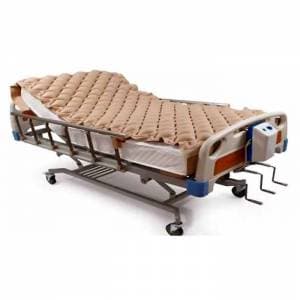
ICU Setup at Home
A commissioned home critical-care package — ICU bed, air mattress, patient monitor, oxygen source and suction — installed and configured together in one visit.
Available on rent or to buy
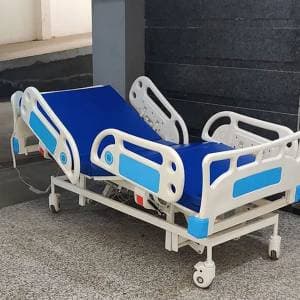
Five-function motorised ICU bed with Trendelenburg tilt, mechanical CPR release and radiolucent platform — for patients discharged on continuing critical care.
Available
Stocked for rental with delivery, installation and servicing included. Tell us how long you need it and we will quote for that period.
Available
Outright purchase including delivery, installation and a one-year warranty on manufacturing defects.
Get the best quote for this equipment
We price against what you actually need — how long, which configuration, whether nursing goes with it — rather than publishing a number that fits nobody. Ask and we will give you a straight one, GST stated separately.
Quotes state GST separately at the applicable rate. Rental and purchase are taxed differently.
An ICU bed differs from a ward bed in the two positions it can reach and the one thing it can undo. Trendelenburg and reverse-Trendelenburg tilt the whole platform head-down or head-up, which matters for circulation, ventilation and drainage in a clinically unstable patient. The mechanical CPR release drops the backrest flat in a single pull, because chest compressions on a raised backrest do not work. Everything runs off a handset with a lockout so a confused patient cannot re-position themselves. This is the bed for someone coming home still on oxygen, still being suctioned, still being monitored.
Which brand you receive depends on current stock. Tell us if you need a specific one and we will confirm before dispatch.
| Functions | 5 — backrest, knee-rest, height, Trendelenburg, reverse-Trendelenburg |
|---|---|
| Operation | Motorised handset with lockout; manual crank backup |
| CPR release | Mechanical, single-pull backrest dropThe one control that has to work under pressure. Check it at every shift handover. |
| Tilt range | ±12° Trendelenburg / reverse |
| Platform | Four-section radiolucent, X-ray cassette channel |
| Side rails | Polymer, collapsible, full length |
| Backup | Internal battery for positioning during a power cutCovers movement only — it is not a substitute for a life-support inverter. |
| Length | 2150 mm overall |
|---|---|
| Width | 990 mm overall |
| Height | 450–800 mm |
| Weight | Approximately 132 kg assembled |
| Load capacity | 250 kg including mattress |
The things that are easy to find out too late.
It is heavy and it needs a lift
At 132 kg the bed cannot be carried safely above the third floor without a service lift. We will decline the installation rather than attempt it — a dropped bed frame in a stairwell is not a recoverable situation.
Tilt is a clinical setting, not a comfort setting
Head-down tilt is contraindicated in raised intracranial pressure and raises aspiration risk. The positions available should be agreed with the treating doctor and not adjusted for comfort.
Still needs a pressure mattress
No bed frame prevents pressure ulcers. An alternating-pressure air mattress is effectively mandatory for a continuously bedbound patient.
Check line slack before every tilt
Ventilator circuits, catheters and infusion lines pull taut when the platform tilts. Dislodging a line is the most common avoidable incident with these beds.
Device information, not medical advice. Suitability for a particular patient is a decision for the treating clinician.
Delivered in sections and assembled in the room where it will be used. The technician levels the frame, fits the mattress and side rails, connects the controls, and demonstrates every position until the carer has operated each one unaided. Castors are locked once the bed is placed, leaving carer access on both sides.
Confirm the patient's weight is within the frame's safe working load, that the doorway clears 800 mm, and that the room allows roughly 2.6 m × 1.8 m with access on both sides. Patients immobile for more than 16 hours a day should have an alternating-pressure mattress arranged at the same time.
Repositioning every two hours remains a nursing requirement — the bed assists it, it does not replace it. Side rails must be raised whenever the patient is unattended. Rental units are stripped, detergent-washed, disinfected and inspected against the manufacturer's reprocessing instructions between patients.
Life-threatening, permanently damaging, or requiring hospitalisation.
Classified Class A (low risk) under India's Medical Devices Rules, 2017. CDSCO classifies devices and licenses manufacturers and importers; it does not license rental or resale providers, and Encone Care makes no claim of CDSCO approval.
We deliver across Delhi NCR only. Check your pincode, or call us and we will tell you honestly whether we can reach you.
Items usually needed alongside this one — chosen because they solve an adjacent problem, not because they cost more.
A commissioned home critical-care package — ICU bed, air mattress, patient monitor, oxygen source and suction — installed and configured together in one visit.
Available on rent or to buy
Multi-parameter bedside monitor covering ECG, SpO₂, non-invasive blood pressure, respiration and temperature, with alarm limits configured at installation.
Available on rent or to buy
Alternating-pressure air mattress with pump — bubble and tubular types — to prevent and manage pressure sores in bedbound patients.
Available to buy
Fully motorised ICU bed with backrest, knee-rest, height, Trendelenburg and reverse-Trendelenburg, mechanical CPR release and radiolucent platform.
Available to buy